The Premier League clash between Chelsea and Arsenal at Stamford Bridge lived up to its billing as a tactical chess match. Both Mauricio Pochettino and Mikel Arteta deployed intricate systems, seeking to exploit the opposition’s weaknesses while neutralizing their strengths. One key battle within this larger tactical framework was Chelsea’s plan to contain Martin Ødegaard, Arsenal’s creative fulcrum. Recognizing the Norwegian’s ability to dictate the tempo and orchestrate attacks, Chelsea implemented a multi-faceted approach to limit his influence on the game.
Disrupting the Conductor: Pressure and Marking
Ødegaard’s impact on Arsenal’s attacking play stems from his intelligent movement, exceptional passing range, and ability to find pockets of space between the lines. To counter this, Chelsea employed a combination of aggressive pressing and close marking aimed at denying him the time and space to operate effectively.
The sources highlight Chelsea’s focus on limiting Ødegaard’s time on the ball. Chelsea’s game plan involved early and physical engagement with Ødegaard, forcing him to receive the ball in less favourable positions. Cucurella, tasked with marking Bukayo Saka, played a crucial role in this strategy. By staying tight to Saka and preventing him from cutting inside, Cucurella forced Ødegaard to drift towards less influential areas of the pitch. This, in turn, allowed Chelsea’s midfielders, particularly Thomas Partey, to closely monitor Ødegaard’s movements and apply pressure whenever he received the ball.
Dean Scoggins, a tactical analyst for The Sun Sport, emphasizes the importance of early engagement and positional discipline in containing Ødegaard: “Cucurella has started with a narrow position and allowed Saka to have the space outside of him and then says we’ll have a race.” This approach, coupled with the support of midfielders like Partey, effectively limited Ødegaard’s ability to receive the ball in dangerous areas.
Furthermore, Chelsea sought to disrupt Arsenal’s passing lanes, preventing Ødegaard from connecting with his teammates and building attacks. This involved disciplined positioning and anticipation, with Chelsea’s midfielders cutting off passing angles and forcing Arsenal to play long balls. This tactic proved particularly effective in the early stages of the match, as Arsenal struggled to establish their usual rhythm and build-up play.
Denying Space: Traffic and Triangles
Beyond individual marking and pressure, Chelsea employed a more collective approach to limit Ødegaard’s space. This involved creating numerical advantages in key areas of the pitch, particularly the central zones where Ødegaard typically thrives.

Recognizing Ødegaard’s tendency to operate between the lines, Chelsea focused on creating traffic in those areas, denying him space to receive the ball and turn. This involved disciplined positioning from Chelsea’s midfielders and defenders, as well as intelligent movement to block passing lanes. Arsenal’s attempts to play through the middle were often met with a wall of blue shirts, forcing them to recirculate possession or resort to less effective attacking options.

Chelsea’s strategy also involved forming defensive triangles around Ødegaard, effectively boxing him in and limiting his options. This involved a coordinated effort between Cucurella, Partey, and Ødegaard’s direct opponent, usually Caicedo or Enzo Fernández. By working in tandem, these players could effectively suffocate Ødegaard, preventing him from receiving the ball in dangerous areas or linking up with his teammates.
Scoggins highlights the effectiveness of this strategy, noting how Arsenal struggled to find solutions: “Arsenal did a great job defensively… Saka was tied up by Cucurella going one way. The other way what they did, Arsenal, was they created a triangle around him, so Thomas Partey comes from one side, Ødegaard drops in, and Saka comes in there and they create this little triangle around him… We’re talking about six yards around him just to stop him getting it. If he’s got it, he’s got a problem.”
Exploiting Weaknesses: Ødegaard’s Defensive Limitations
While Ødegaard is undoubtedly a gifted playmaker, he possesses certain defensive weaknesses that Chelsea sought to exploit. Notably, Ødegaard’s lack of pace and physicality can be exposed in transition, particularly when forced to track back against quick opponents.
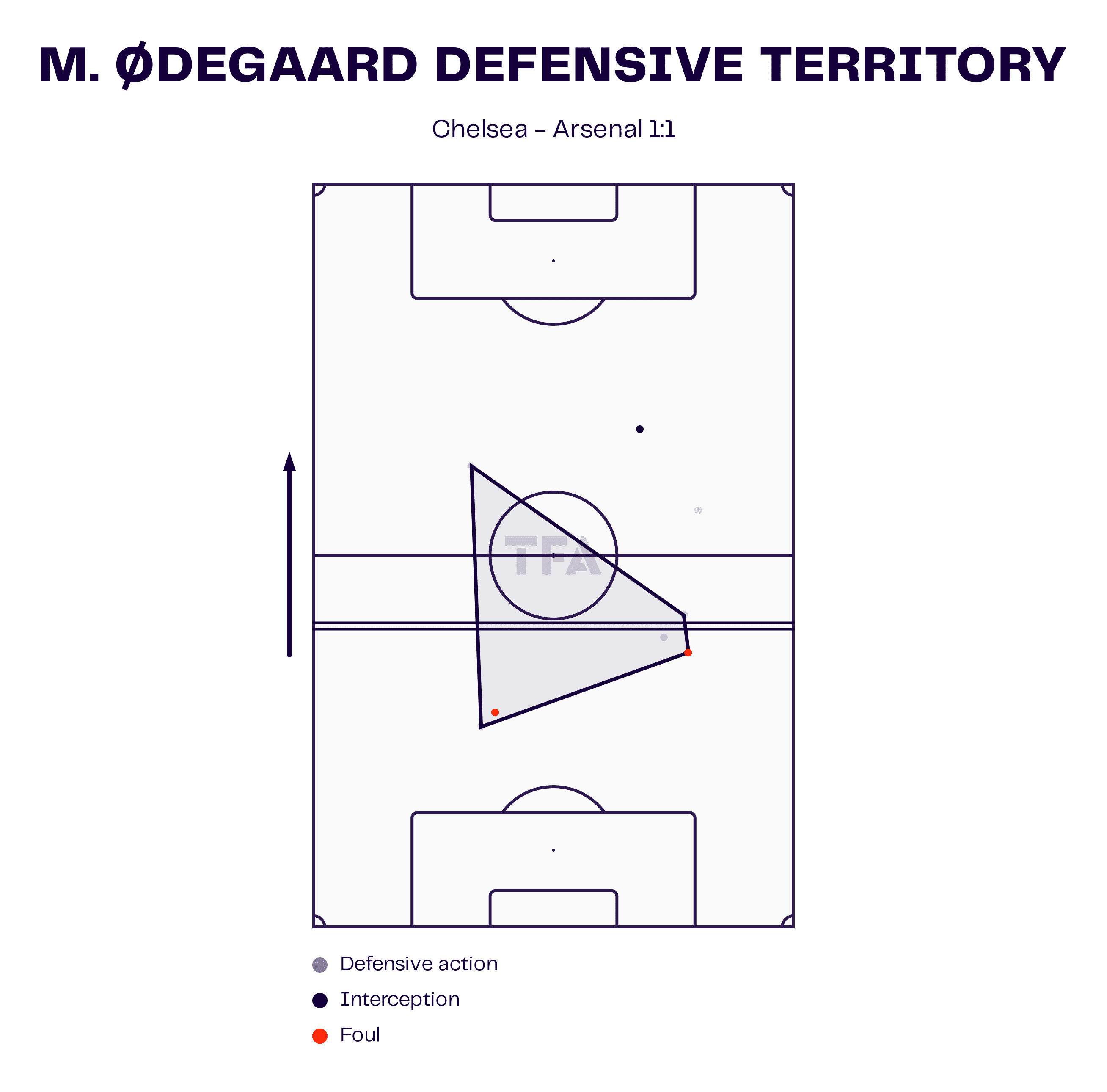
Chelsea recognized this vulnerability and looked to exploit it through rapid counter-attacks, aiming to catch Ødegaard out of position and create overloads in wide areas. This tactic involved quick transitions from defence to attack, with players like Nicolas Jackson making runs in behind Arsenal’s defence. While Chelsea were not always clinical in their finishing, they consistently created dangerous situations by targeting the space vacated by Ødegaard during transitions.
Furthermore, Chelsea utilized the pace and directness of players like Mykhailo Mudryk and Noni Madueke to target Ødegaard directly in one-on-one situations. This forced Ødegaard to defend deeper and expend energy tracking runners, further limiting his offensive output.
Adapting to the Maestro: Tactical Tweaks and Adjustments
Throughout the match, both Arteta and Maresca made tactical adjustments in response to the evolving dynamics of the game. Chelsea, in particular, had to adapt to Arsenal’s attempts to free Ødegaard from their defensive shackles.

One of Arsenal’s key adjustments was to have Ødegaard drop deeper into midfield, seeking to escape Chelsea’s suffocating pressure higher up the pitch. This allowed him to receive the ball with more time and space, potentially dictating play from a deeper position. However, Chelsea responded by adjusting their defensive shape, with midfielders dropping deeper to maintain their close marking of Ødegaard.


Another tactic employed by Arsenal was to utilize the overlapping runs of Jurrien Timber and Ben White to create overloads on the flanks. This aimed to stretch Chelsea’s defence and create space for Ødegaard to exploit in central areas. However, Chelsea countered this by having their wingers track back diligently and provide defensive support, limiting the effectiveness of Arsenal’s overlapping runs.
Conclusion: A Battle Won, but the War Continues
Chelsea’s plan to neutralize Ødegaard proved largely successful. While the Norwegian still displayed glimpses of his talent, he was unable to exert his usual influence on the game. Chelsea’s combination of aggressive pressing, close marking, and intelligent positioning effectively limited Ødegaard’s time on the ball and disrupted Arsenal’s attacking rhythm.
However, this tactical battle was just one aspect of a captivating encounter between two of the Premier League’s most tactically astute managers. The draw highlighted the fine margins that often separate success and failure at the highest level. As both teams continue to evolve and refine their tactical approaches, the battle between Pochettino and Arteta, and the quest to contain creative maestros like Ødegaard, promises to be a fascinating subplot in the unfolding Premier League narrative.
Visuals via TFA data viz engine