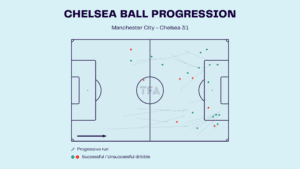
Cole Palmer arrived at Chelsea with the weight of expectation on his young shoulders. The talented attacking midfielder, signed from Manchester City for a considerable fee, was seen as the missing piece in Mauricio Pochettino’s attacking puzzle. In his early appearances, Palmer showcased the dynamism and creativity that made him such a coveted prospect. However, in recent matches, particularly against Arsenal, he has struggled to replicate that early-season form.
This dip in performance coincides with tactical tweaks implemented by Maresca, specifically the decision to invert right-back Malo Gusto into midfield. While this manoeuvre has bolstered Chelsea’s midfield structure, it has inadvertently impacted Palmer’s ability to find space and influence the game. The question now arises: can Palmer adapt and thrive within this fluid system, or will he become a victim of his own versatility?
The Impact of Gusto’s Inverted Role

To understand Palmer’s recent struggles, we need to examine how Gusto’s inverted role affects Chelsea’s attacking shape. In their preferred 3-2 build-up, Gusto vacates his traditional right-back position and pushes into the right half-space, forming a box midfield alongside Enzo Fernández, Moisés Caicedo, and Ben Chilwell.

While this creates numerical superiority in midfield and allows Chelsea to control possession, it forces Palmer to shift to the left side. This positional change takes him away from his favoured right-hand side, where he can cut inside onto his stronger left foot.
This tactical shift was particularly evident in the Arsenal game, where Cucurella, the left-back, was tasked with man-marking Saka. This meant that inverting Cucurella was not an option, forcing Palmer to operate from the left. As Dean Scoggins, a tactical analyst for The Sun Sport, pointed out, “It’s a bit of a worry for Chelsea that going into well, two weeks ago, Palmer was top for everything… shots on target from midfield, assists, key passes… last two games nothing, zero, no assists, no, barely a shot. [He] had one shot on target, I think, in the last two games, really, really anonymous for him.”

The heat map from the Arsenal match illustrates Palmer’s lack of involvement. The absence of any significant red zones indicates that he was rarely able to receive the ball in dangerous areas. Arsenal, well aware of Palmer’s threat, effectively formed a tight triangle around him, denying him space to operate.


Scoggins elaborates, “Arsenal did a great job defensively… Saka was tied up by Cucurella going one way. The other way what they did, Arsenal, was they created a triangle around him, so Thomas Partey comes from one side, Ødegaard drops in, and Saka comes in there and they create this little triangle around him… We’re talking about six yards around him just to stop him getting it. If he’s got it, he’s got a problem.”
Palmer’s Adaptability: Finding Solutions in a Fluid System
Despite the challenges posed by Chelsea’s tactical fluidity, Palmer possesses the talent and intelligence to adapt and thrive. His ability to play across the attacking line is an asset that Maresca can leverage to create matchup problems for opponents.

One potential solution is to encourage Palmer to operate in the half-spaces, finding pockets of space between the lines. This would allow him to receive the ball facing forward and utilize his dribbling skills and passing range to unlock defences.
Another option is to deploy Palmer as a false nine, utilizing his movement and link-up play to create space for runners from midfield and the wings. His ability to drop deep and draw defenders out of position could create opportunities for players like Noni Madueke and Mykhailo Mudryk to exploit the space behind.
Furthermore, Palmer can learn from the best. Comparisons to Lionel Messi might be premature, but the underlying principle remains valid. Messi, despite playing predominantly on the right wing, mastered the art of finding space and dictating the game from a seemingly fixed position. Palmer, with his technical ability and tactical awareness, can emulate this approach, becoming a focal point for Chelsea’s attack even when operating in a less familiar role.
Maresca’s Role in Unlocking Palmer’s Potential

Maresca’s role in facilitating Palmer’s adaptation is crucial. The Chelsea manager needs to strike a balance between tactical structure and individual freedom, allowing Palmer the space to express himself while maintaining the team’s overall shape.

Clear communication and well-defined roles are essential. Palmer needs to understand his responsibilities within the system and how his movements can create opportunities for his teammates. Maresca must also provide Palmer with the confidence to take risks and try things, even if they don’t always come off.
Training sessions focused on combination play and off-the-ball movement can help Palmer refine his understanding of teammates. Working on his spatial awareness and decision-making under pressure will also be vital in overcoming the tight marking he is likely to face.
Furthermore, Maresca could consider tactical tweaks that maximize Palmer’s strengths. Utilizing rotations with other attackers or deploying him in a more central role in certain situations could provide him with the freedom he needs to flourish.
Conclusion: A Bright Future Awaits
Cole Palmer’s recent struggles are a natural consequence of adapting to a new team and a fluid tactical system. The challenge now is for both the player and the manager to find solutions that unlock his immense potential.
Palmer’s talent is undeniable. He possesses the technical ability, tactical awareness, and creative spark to become a key player for Chelsea. With Maresca’s guidance and his own adaptability, Palmer can overcome these early hurdles and find his rhythm in a shifting Chelsea attack. The journey might be challenging, but the destination promises to be spectacular.
Visuals via TFA data viz engine